

 Call us:



Intermediate Chemistry: Halogens & Alkaline Earth Metals
-
 By
Advance Learning - Chemistry
- 11/11/2022
Course Description
Magnesium, one of the group 2 elements, is used in fireworks due to the bright white flashes formed when it burns in the presence of oxygen. Find more about magnesium and the rest of the group’s elements in this course. The first module is about alkaline earth metals, including beryllium, magnesium, calcium, barium, strontium and radium, which are located in the second column of the periodic table. Discover how they form metallic bonds, and how the atomic numbers increase going down group 2, which increases the nuclear charge. Adding an extra shell down the group increases the shielding effect, causing a decrease in the melting points. After that, we investigate the chemistry of group 2 elements and how they form basic oxides that partially dissolve in water, forming alkaline or slightly alkaline solutions.
The flame test, used to differentiate elements based on their different emission colours using a non-luminous Bunsen flame, is then described. Next, we contrast the solubilities of group 2 sulphates and hydroxides, as well as the decomposition of group 2 carbonates and nitrates, which results in the formation of oxides. Calcium carbonate occurs in nature in many forms; the two most common are limestone and marble, used in building houses for bricks or floors.
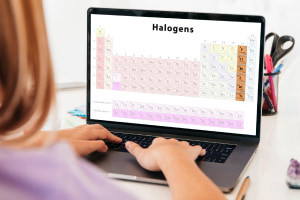
The next module covers group 17 elements, known as halogens, which are found in the column before the last on the right side of the periodic table. You'll notice that fluorine and chlorine are gases, bromine is a liquid, and iodine and astatine are solids at room temperature. Then you'll understand how, as you move down group 17, the atomic number rises, causing the atomic radius and Van der Waals forces to increase. After that, we explore the reactions of halogens with metals and hydrogen gas to form ionic compounds and halogen halides, as well as how we can use silver nitrate to distinguish between various halide ions. The course concludes with halogens industrial applications, including the chlorination of water and the production of bleach and PVC. Enrolment is free and there is optional certification available.
What you'll learn in this course?
-
Inorganic Chemistry
-
Chemistry
Course Curriculum

Advance Learning - Chemistry
Galway, Ireland
$20.00
Course includes:
-
 Duration
1.5-3 hrs
-
 Modules
3
-
 Certifications
certificate
After you complete the course, receive a digital certificate or request a printed copy shipped to you.
