

 Call us:



Introduction to Elements, Atoms and the Periodic Table
-
 By
Khan Academy
- 29/07/2019
Course Description
We all know that an atom is the basic unit of a chemical element and is made up of three kinds of particles. With this course, you will look closely into these subatomic particles namely protons, neutrons, and electrons. You will also study valence electrons which are outer shell electrons associated with an atom. In addition, you will learn about orbitals, the periods and groups in the Periodic Table, and the electronic configuration of an element.
You will then study ionization, the process by which an atom or a molecule acquires a negative or positive charge by gaining or losing electrons. This often happens in conjunction with other chemical changes. You will learn that the resulting electrically charged atom or molecule is called an ion. What's more? You will study the different types of chemical bonds which include ionic, covalent, and metallic bonds as well as the Periodic Table trends.
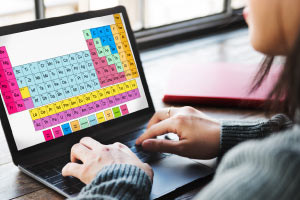
This course will give you a comprehensive view of the core building blocks in chemistry. Once you gain better insight into the makeup of atoms and elements, it becomes both easier and more interesting to study the Periodic Table of Elements. You will also study the attraction and repulsion between subatomic particles acts according to Coulomb's Law. If you want to dig deeper into some of the groups of the periodic table such as noble gases, alkaline earth metals, alkali metals and halogens, take this course today!
What you'll learn in this course?
-
Inorganic Chemistry
-
Science
-
Chemistry
Course Curriculum
- Learning Outcomes
- Elements and Atoms
- Introduction to the atom
- Orbitals
- More on orbitals and electron configuration
- Electron Configurations
- Electron Configurations 2
- Valence Electrons
- Groups of the Periodic Table
- Periodic Table Trends: Ionization Energy
- Other Periodic Table Trends
- Ionic, Covalent, and Metallic Bonds
- Lesson Summary

Khan Academy
Worldwide
$20.00
Course includes:
-
 Duration
3-4 hrs
-
 Modules
2
-
 Certifications
certificate
After you complete the course, receive a digital certificate or request a printed copy shipped to you.
